
Best Dog Harness for Trail Riding and Biking (2026) — What Actually Works on Real Trails
Top Pick — Quick Answer
🏆 Best Overall: Ruffwear Front Range Harness
The Ruffwear Front Range is the most recommended trail dog harness across cycling communities, outdoor forums, and verified buyer reviews. Y-front chest design, four adjustment points, dual clip rings, padded panels. Works for all trail types and all breeds. The go-to recommendation for first-time trail dog owners — and experienced ones.
Our Top Picks — Best Dog Harness for Trail Riding at a Glance
If you’re short on time, here are our top recommendations. Each pick is explained in full detail below.
Quick Comparison Table — Best Dog Harnesses for Trail Riding (2026)
Compare all 5 dog harness side by side on the specs that matter most for trail riding:
| # | Harness | Best For | Y-Front | Handle | Clips | Weight | Amazon Price |
|---|---|---|---|---|---|---|---|
| #1 | Ruffwear Front Range ⭐ Best Overall | Best Overall | Yes | No | Front + Back | Light | Check Price |
| #2 | Rabbitgoo Dog Harnes 🏕️ Budget Trail + No Pull | Trail Biking + Lifting | Yes | Yes | Front + Back | Light | Check Price |
| #3 | Kurgo Enhanced Strength Tru-Fit 💰 Budget + Car Safety | Budget + Car Safety | No | No | Front + Back | Medium | Check Price |
| #4 | ICEFANG Tactical Harness 🛒 𝗔𝗺𝗮𝘇𝗼𝗻 #4,132 in Pet Supplies | Bikejoring | Yes | Yes | 2 Leash Clips | Medium | Check Price |
| #5 | Best Pet Supplies Voyager 🛒 𝗔𝗺𝗮𝘇𝗼𝗻 #53 in Pet Supplies | All weather and condition | Yes | No | Yes | Medium | Check Price |
Affiliate Disclosure: As an Amazon Associate, DogToysReport.com earns from qualifying purchases at no extra cost to you. Prices and availability may vary.
Is a Regular Harness Enough for Trail Riding?
If you ride trails with your dog, you already know that a regular walking harness was not built for this.
The harness your dog wears to the park is fine for slow walks on flat pavement. But the moment you take it onto a dirt trail — with your dog running beside your bike, pulling through corners, scrambling over roots and rocks — that same harness starts working against you. This restricts shoulder movement. It chafes under the legs. It slides out of position mid-ride. And if your dog is attached to a bike via a bungee leash, a poorly fitting harness can turn a sudden pull into a dangerous situation for both of you.
Trail riding with your dog demands a different kind of harness entirely. One that moves with your dog instead of fighting them. Another one that distributes pressure correctly when they pull. Final one that stays in place over miles of uneven terrain, not just around the block.
This guide covers exactly that. We researched the most popular trail dog harnesses, cross-referenced hundreds of verified owner reviews, and broke down what actually matters when your dog is running beside a mountain bike or electric mountain bike on real trails. Whether you ride eMTBs, hardtail mountain bikes, or simply hike long trails with your dog, this guide will help you choose the right harness for how you actually ride.
Why a Regular Harness Fails on Trails
Most dog harnesses are designed for one purpose: stopping a dog from pulling on a city walk. That design logic falls apart completely once you take your dog onto a trail beside a bike. Here is what goes wrong:
Shoulder restriction
Many budget harnesses use a straight chest strap that sits across the front of your dog’s shoulders. On a trail run beside a bike it limits your dog’s natural stride length, causes a shortened unnatural gait, and leads to faster fatigue and long-term joint stress.
Armpit chafing
Standard harnesses sit too tight under the front legs. During extended movement on trail runs, the harness rubs constantly against the skin. You may not notice the damage until the ride is over and you find raw, irritated patches under your dog’s front legs.
Pressure on the wrong points
When a dog pulls on a leash attached to a poorly positioned harness, force concentrates on a single point — usually the back clip. On a trail bike setup with a bungee leash this creates uneven tension that can yank your dog off balance when they surge forward or change direction suddenly at speed.
Poor stability under movement
Harnesses with only one or two adjustment points shift position during vigorous activity. A harness that starts correctly positioned can slide sideways after twenty minutes of running — putting clips in the wrong place precisely when you need them most.
No handle for technical terrain
On real trails you will need to physically assist your dog — lifting them over fallen logs, steadying them on steep sections, or quickly pulling them back. A trail harness needs a solid handle. Most walking harnesses do not have one.
What Makes a Harness Trail-Ready
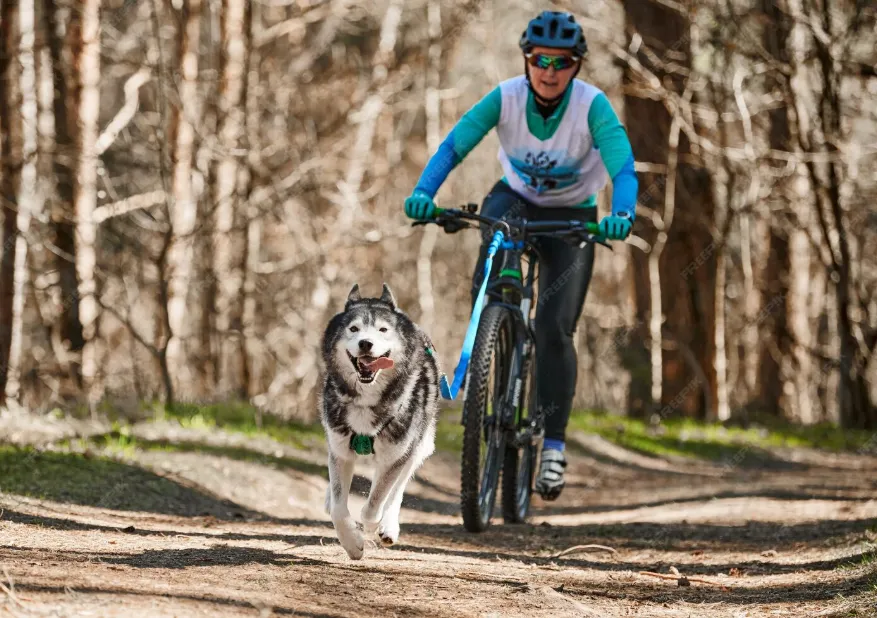
Not every harness marketed as ‘outdoor’ or ‘adventure’ is genuinely built for trail biking. These five design features separate a real trail harness from a marketing label:
Y-front design
The single most important feature. A Y-shaped chest piece opens the shoulder area and allows your dog’s front legs to extend fully with every stride. If the chest strap runs straight across — put it back. Non-negotiable for any harness used during extended running or biking.
Back attachment point — or dual attachment
For trail biking your leash always attaches to the back of the harness, not the front. Front-clip harnesses create unnatural pulling angles with bike leash systems and cause dogs to spin, trip, or fight their direction of travel.
Padded chest and belly panels
Trail rides mean extended contact between harness and skin over many miles. Look specifically for padding on the chest panel and under-belly strap — the two highest-friction zones during forward movement. Avoid excessively thick padding which traps heat.
Four or more adjustment points
Look for at least four: neck circumference, chest panel, and both sides of the girth strap. This lets you dial in a snug, stable fit that does not shift during movement. Even slightly too loose and the harness rotates. Too tight and it restricts breathing during high-intensity running.
Top handle — rigid and well-stitched
A solid handle sewn onto the back panel is essential for trail use. It must be rigid enough to grip firmly under real load. Soft fabric handles that fold when you grab them are useless in a genuine trail situation. Check the stitching around the handle — this is the part most likely to fail under stress on cheaper harnesses.
Top 5 Dog Harnesses for Trail Riding (Full Reviews)
🏆 #1 — Ruffwear Front Range Harness [ Best Overall ]
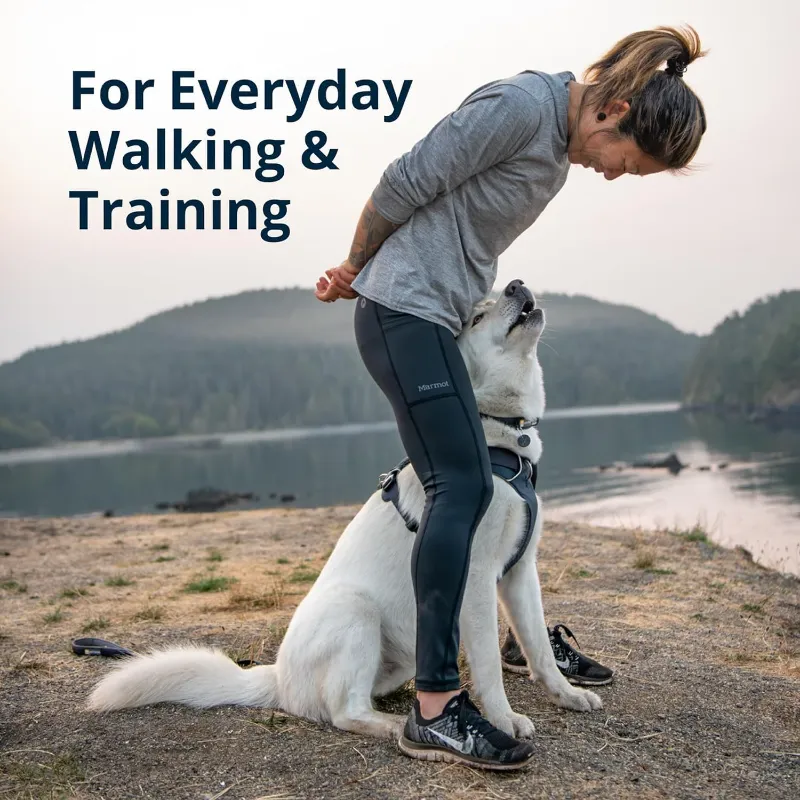
The Ruffwear Front Range is the most recommended trail dog harness across cycling communities, outdoor forums, and verified buyer reviews. The Y-front chest piece keeps both shoulder joints completely free during running — your dog moves naturally at full stride rather than fighting a strap across their chest for every mile.
Four fully independent adjustment points let you achieve a snug, stable fit on almost any body shape. Once set correctly, this harness stays put through sustained running, scrambling, and directional changes without shifting. Owners consistently report zero chafing even after full-day hikes and trail rides.
Two leash attachment points — a back V-ring for trail biking and a front chest ring for walk-based pull correction — give everyday versatility. The one notable omission is a top handle. If your trails include technical sections where you regularly need to lift or assist your dog, read the Flagline review below.
✅ PROS
- Y-front design keeps shoulders fully free
- Four adjustment points for precise, stable fit
- Dual leash attachment — back trail clip + front walk clip
- Padded panels prevent chafing on long rides
- Machine washable — handles real trail conditions
- Available in XXS through XL — widest size range
❌ CONS
- No top handle for lifting on technical terrain
- Not ideal for very strong pullers in bikejoring setups
- Higher price than budget options
Best For
Dogs of any size running beside a mountain bike or eMTB on moderate trails. Ideal for owners who want one harness for both trail riding and daily walks.
🛒 Buy on Amazon: Check Price & Availability — Ruffwear Front Range Harness → (Amazon Affiliate Link — supports this site at no extra cost to you)
⚡ #2 — Rabbitgoo Dog Harness [ Best Budget Harness for Casual Trail Riders ]
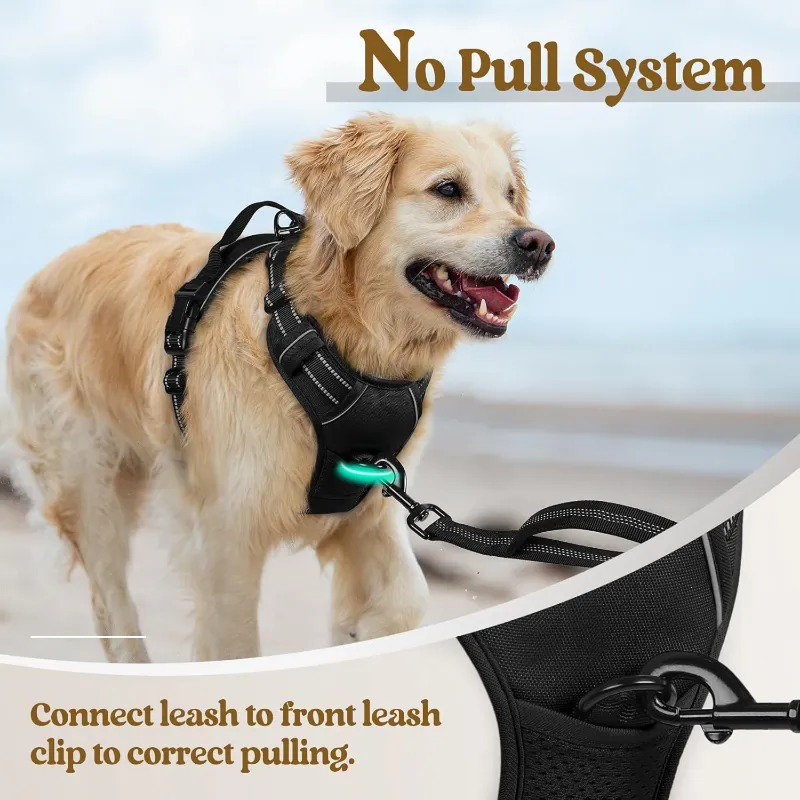
The Rabbitgoo No Pull harness is the most accessible entry point on this list — a well-featured harness at a price that makes it an easy first buy for new trail dog owners who want dual leash clips without committing to a premium price. Its over-the-head design fits similarly to the Ruffwear Front Range and is one of the most reviewed dog harnesses on Amazon for a reason.
Four adjustment points let you dial in a reasonably snug fit across a wide range of body types. Two metal leash attachment points — a back ring for trail use and a front chest ring for pull correction — cover the basics well. A top handle on the back panel gives you quick grab control when your dog gets close to traffic or needs steadying on a step.
The honest limitation for trail biking use: hardware is aluminum rather than steel, and a small number of owners report buckle wear after heavy sustained use. For casual trail riders at moderate pace with dogs under 60 lbs, the Rabbitgoo performs reliably. For large, powerful dogs or sustained bikejoring, step up to a more structurally reinforced harness.
✅ PROS
- Dual leash clips — front and back metal rings
- Four adjustment points for a stable, customizable fit
- Top handle for quick control on trail
- Breathable padded mesh — comfortable for longer outings
- Reflective trim for low-light visibility
- Available in multiple sizes and colors
❌ CONS
- Aluminum hardware — less robust than steel at sustained high loads
- Not a true Y-front — some shoulder restriction possible during hard running
- Sizing can run inconsistent — measure carefully before ordering
Best For
Budget-conscious trail dog owners with small to medium dogs running beside a bike at casual to moderate pace. A strong first harness for riders not yet ready to invest in premium gear.
🛒 Buy on Amazon: Check Price & Availability — Rabbitgoo Dog Harness → (Amazon Affiliate Link — supports this site at no extra cost to you)
💰 #3 — Kurgo Tru-Fit Enhanced Strength Harness [ Best Budget Pick With Car Safety ]
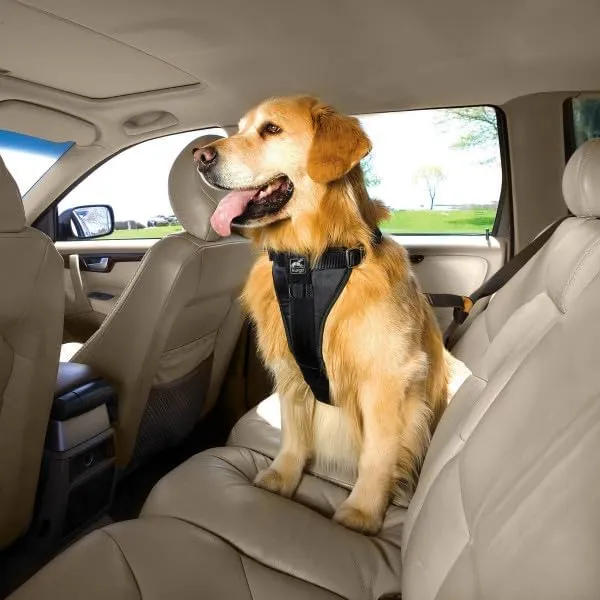
The Kurgo Tru-Fit is the most practical option for trail dog owners who want a capable harness at a lower price point — and who also need it to double as a car safety restraint. Crash-safety tested for dogs up to 75 pounds, it connects directly to a standard seatbelt receiver via the included strap. For owners who drive to trailheads regularly, this eliminates the need for a separate car harness entirely.
Five adjustment points — more than most harnesses in this price range — allow for a reasonably precise fit. Steel hardware throughout feels notably solid for the price. The chest design is not a true Y-front, so some shoulder restriction is possible during hard running. For casual to moderate trail pace at controlled speed, the Tru-Fit performs well and represents strong value.
✅ PROS
- Crash-tested car safety restraint — one harness for trail and car
- Five adjustment points — better fit than most budget options
- Steel hardware — durable at the price point
- Front and back leash clips
- 3,600+ Amazon ratings — proven track record
❌ CONS
- Not a true Y-front — some shoulder restriction during hard running
- No top handle
- Padding less substantial than premium options
Best For
Budget-conscious owners who drive to trailheads and want one harness for car travel, casual trail hiking, and moderate trail riding. Excellent first harness for new trail dog owners.
🛒 Buy on Amazon: Check Price & Availability — Kurgo Tru-Fit Harness → (Amazon Affiliate Link — supports this site at no extra cost to you)
🛡️ #4 — ICEFANG Tactical Dog Harness [ Best for Control, Durability, and Adventure Dogs ]
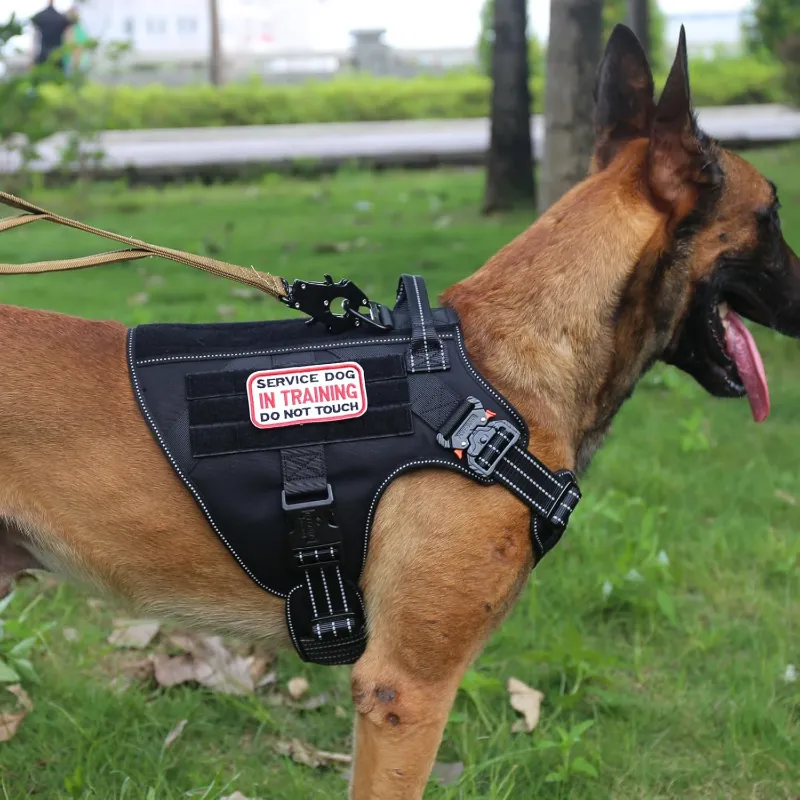
If your trail dog is a large, powerful, or high-energy breed — or if you want gear built to genuinely withstand rough conditions — the ICEFANG Tactical Harness is the most structurally serious option on this list. Built from 1050D nylon with metal buckles rated to 1000 lbs proof-load, this is the harness that owners of working breeds, German Shepherds, Pitbulls, and similar dogs consistently reach for when other harnesses have failed them.
Five adjustment points deliver a precise, stable fit that holds its position during sustained activity. The padded top handle is reinforced and genuinely functional for lifting, controlling, or assisting a large dog on technical terrain. Dual leash attachment points — front anti-pull ring and rear V-ring — handle both training and trail riding setups. MOLLE webbing on the sides lets you attach water bottle holders, pouches, or ID patches directly to the harness — useful for longer trail days where you want your dog to carry their own supplies.
The tradeoff is weight and bulk. This is the heaviest harness on this list, and some dogs with shorter natural strides may find the structure slightly restrictive during extended running. It is also hand-wash only, which takes more maintenance than machine-washable options. For dogs that have previously slipped or broken lighter harnesses, the security margin here is unmatched at this price point.
✅ PROS
- 1000 lb proof-load metal buckles — strongest hardware on this list
- MOLLE webbing — attach water, pouches, or patches for long trail days
- Reinforced padded top handle — functional for lifting large dogs
- Front and rear leash attachment points
- Five adjustment points for a snug, escape-resistant fit
- 1050D nylon construction — holds up to abrasion, brush, and wet conditions
❌ CONS
- Heaviest harness on this list — noticeable on smaller or lighter dogs
- Not machine washable — hand wash required
- Bulkier fit — may restrict movement slightly on dogs with short natural strides
- Sizing runs specific — measure girth carefully, not by weight
Best For
Large, powerful, or escape-prone breeds on trail biking adventures. Owners who want one harness that doubles as a gear carrier. Dogs that have previously broken or slipped lighter harnesses.
🛒 Buy on Amazon: Check Price & Availability — ICEFANG Tactical Dog Harness → (Amazon Affiliate Link — supports this site at no extra cost to you)
🌬️ #5 — Best Pet Supplies Voyager Step-In Air Harness [ Best for Small Dogs and Heat-Sensitive Breeds ]
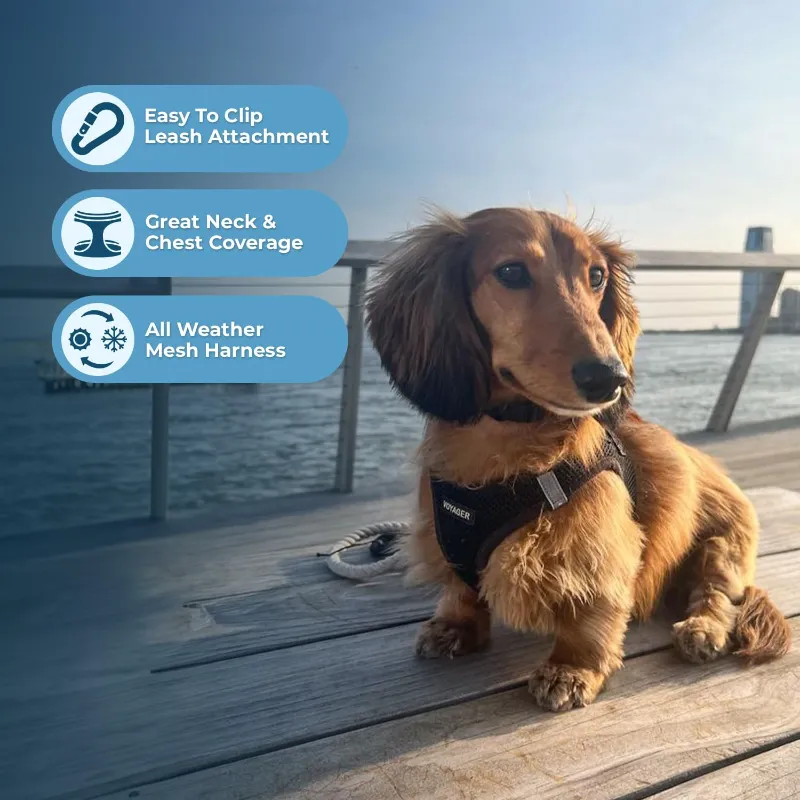
The Voyager Step-In Air Harness fills a specific gap that most trail harnesses on this list don’t address: small dogs and heat-sensitive breeds that need the lightest, most breathable option available. The step-in design — your dog simply steps into the leg loops and you clip it closed — is the easiest fitting method of any harness here, and removes the over-the-head struggle entirely for dogs that are head-shy or nervous about gear.
Triple security closure — hook and loop fastener, buckle, and double D-rings — means the harness stays on even on active, wriggly dogs despite its lightweight construction. Breathable air mesh keeps small dogs cool during warm-weather trail rides where heat management matters more than structural bulk. Two reflective bands provide visibility on early morning and evening outings. With over 67,000 Amazon ratings at 4.6 stars, the owner track record is extensive.
The honest limitation for trail biking: this is a casual trail and light outdoor harness. There is no top handle, no Y-front design, and the single back D-ring attachment is adequate for leash walking and light trail use but is not purpose-built for sustained biking speeds or strong pullers. For small dogs running alongside a bike at a relaxed pace on flat to moderate terrain, the Voyager is comfortable, secure, and well-priced. For any dog over 40 lbs or a fast trail pace, choose a harness higher on this list.
✅ PROS
- Step-in design — easiest to put on of any harness here
- Lightest and most breathable option on this list
- Triple security closure — hook and loop, buckle, and double D-rings
- Reflective bands for low-light visibility
- Available in sizes XXXS to XL — widest small-dog size range
- 67,000+ Amazon ratings — extensively proven in real owner use
❌ CONS
- No top handle
- No Y-front design — not built for sustained high-speed running
- Single back attachment only — no front no-pull ring
- Not recommended for dogs over 40 lbs on active trail biking
Best For
Small dogs and cats running at a relaxed pace on easy trails. Heat-sensitive breeds. Owners who prioritize ease of fitting and lightweight comfort over trail-biking-specific performance.
🛒 Buy on Amazon: Check Price & Availability — Best Pet Supplies Voyager Step-In Air Harness → (Amazon Affiliate Link — supports this site at no extra cost to you)
Trail Rating Table
| Harness | Trail Rating | Best Trail Type |
|---|---|---|
| Ruffwear Front Range | ⭐⭐⭐⭐⭐ | All trail types, all breeds |
| Rabbitgoo Dog Harnes | ⭐⭐⭐⭐⭐ | Budget Trail + No Pull / Casual Riders |
| ICEFANG Tactical Harness | ⭐⭐⭐⭐½ | Large, powerful, or escape-prone breeds |
| Kurgo Tru-Fit Enhanced | ⭐⭐⭐½ | Moderate trails, budget, car use |
| Best Pet Supplies Voyager | ⭐⭐⭐½ | Side-ring bike setups, sensitive dogs |
Buying Guide: How to Choose by Dog Size and Trail Type
Small dogs under 20 lbs
Small dogs have proportionally different body shapes and many harnesses fit poorly on small frames regardless of size label. Prioritize harnesses with the most adjustment points and granular sizing. The Ruffwear Front Range in XXS or XS is the most consistently well-fitting for small breeds. Avoid heavy padding — small dogs overheat faster and a thick padded harness becomes a heat trap on warm days.
“For small active dogs, pairing the right harness with the right toys for small active dogs helps maintain energy and focus between rides.”
Medium dogs 20–50 lbs
This is the most well-served size range across all five harnesses. For medium dogs running beside a mountain bike or eMTB, the Ruffwear Front Range or Flagline will fit well across the widest range of body types.
If your medium dog pulls hard and runs energetically beside the bike, step up to the ICEFANG Tactical for its superior hardware strength and secure fit.
Large dogs over 50 lbs
Large dogs generate significantly more pulling force, which puts more stress on harness attachment points and stitching. Prioritize hardware quality — steel rings over plastic, reinforced stitching around attachment points. The Ruffwear Flagline with its reinforced handle is the strongest choice for large dogs on technical terrain. The Kurgo Tru-Fit is crash-tested to 75 lbs and performs well at moderate trail pace.
Casual trail hiking pace
If you hike trails with your dog — not attached to a bike — any of the five harnesses on this list will perform well. Prioritize comfort and fit over bike-specific features. The Ruffwear Front Range is the most versatile choice.
Moderate trail biking — dog running beside the bike
The Ruffwear Front Range is the best starting point. Y-front keeps movement natural, fit is stable, dual clip handles both trail biking and daily walks. If your trails include technical sections where your dog needs assistance, upgrade to the Flagline for the handle.
High-speed biking and bikejoring
For high-speed biking and dogs that pull hard, the ICEFANG Tactical Harness is the strongest structural choice on this list. Its 1000 lb proof-load metal buckles and five adjustment points keep the harness locked in position during sustained pulling — and the MOLLE webbing means you can carry gear directly on the harness for longer trail days.
Dogs using a dedicated bike leash attachment system
If you use a Walky Dog, Bike Tow Leash, or similar side-mounted system, the ICEFANG Tactical’s dual leash attachment points offer the most flexible connection options of any harness on this list.
Bike Leash Systems Explained
A great harness is only half the equation. How you connect your dog to your bike matters just as much — and the wrong leash system will create problems regardless of how good your harness is. There are three main systems used for trail riding with dogs.
Hands-free waist leash
The simplest setup. A bungee leash clips to your dog’s harness and attaches to a belt around your waist. Your hands stay on the handlebars at all times. The bungee absorbs sudden pulls and direction changes, reducing the jolt transferred to you and your dog simultaneously. Best for smaller to medium dogs and casual riding pace on moderate terrain. The Ruffwear Roamer Leash is the most recommended for this setup.
Bike attachment arm
A rigid arm clamps to your bike’s seatpost or frame and extends sideways, keeping your dog at a fixed distance from the rear wheel. Your dog runs beside the bike rather than in front of it. The arm absorbs sideways pulling forces mechanically rather than transferring them to your body. The Walky Dog Plus and Bike Tow Leash are the two most established options. Works best on wider trails and gravel paths — tight singletrack corners can create handling challenges.
Bikejoring antenna system
The most specialized setup used by bikejoring athletes. An antenna attaches to the bike’s steerer tube above the stem and extends forward. The bungee leash runs from the antenna down to your dog’s harness, with the dog running in front and pulling the bike.
For dogs that naturally pull hard and run fast at the front of the bike, the ICEFANG Tactical Harness is the strongest option on this list for channeling that energy safely — its metal buckle system handles sustained pulling force better than any other harness here.
Trail Safety Tips for Riding With Your Dog
Check your dog's paws before and after every ride
Trail surfaces — especially rocky singletrack, gravel, and dry compacted dirt — are abrasive to dog paw pads in a way that pavement is not. Before your ride, check that pads are not already cracked or sore. After, check for cuts, embedded debris, and early signs of wear. For regular abrasive surfaces, consider dog booties or paw protection wax like Musher’s Secret.
Bring more water than you think you need
Dogs regulate heat primarily through panting, and a dog running hard beside a bike on a warm day can dehydrate and overheat faster than you expect. Carry a collapsible dog bowl and enough water for your dog to drink at every rest stop. Offer water every 20 to 30 minutes on warm days, every 45 minutes on cool days.
Watch for overheating signs actively
Excessive panting that does not slow during rest, glazed eyes, stumbling, or reluctance to continue are all signs your dog needs to stop immediately. Move to shade, offer water, and give your dog time to recover before considering continuing.
Match your pace to your dog's fitness level
Your eMTB can sustain a pace far beyond what your dog can safely maintain, especially on warm days or elevation-heavy terrain. Ride at your dog’s pace. If your dog is slowing down, that is the signal to slow your ride.
So you need some action and preperation for your dog also as “Interactive toys to keep trail dogs mentally stimulated”.
Know the trail rules for dogs before you go
Trail access for dogs varies significantly by location. Many trail systems allow dogs on leash only. Some singletrack trails specifically prohibit dogs. Always check trail regulations before your ride.
Carry a basic dog first aid kit
Gauze, adhesive bandages, antiseptic wipes, and tweezers for thorn removal weigh almost nothing and can make a significant difference if your dog picks up a trail injury. A folding emergency dog rescue sling is worth adding if you ride remote trails far from the trailhead.
The eMTB Advantage for Trail Rides With Your Dog
One thing most trail dog guides overlook entirely is how much your bike choice affects your dog’s safety and experience on the trail.
A conventional mountain bike requires you to maintain your own momentum constantly. On climbs, you are focused on your own effort and cadence. On descents, you are managing your speed. Both situations make it harder to monitor your dog, react to their movements, and adjust your pace to match theirs in real time.
An electric mountain bike changes this dynamic significantly. Motor assistance on climbs means you are not working at your limit — you have attention and control to spare for your dog. On trails, a lower assist mode lets you match your dog’s natural running pace without the bike pulling ahead. When your dog slows or stops, you can respond instantly without losing momentum on a climb that demands constant pedaling.
The speed control advantage is the most important factor for trail riding with a dog. On a regular mountain bike, controlling speed on descents while managing a dog on a leash beside you requires significant skill. On an eMTB with motor assistance and smoother power delivery, maintaining a consistent, dog-safe pace on varied terrain is significantly more manageable.
Planning a Trail eMTB Ride With Your Dog?
For riders considering an electric mountain bike for trail rides with their dog, our full guide covers the best electric mountain bikes for trail riding in 2026 — including which bikes offer the best speed control and motor smoothness for riding at a dog-friendly pace.
If you’re looking to get started without a big investment, there are genuinely trail-capable options available at an accessible price point. Our breakdown of the best electric bike under $1000 covers seven budget eMTBs tested for trail use — including which ones offer the smoothest motor control for riding at a dog-friendly pace.
Frequently Asked Questions — Best Dog Harness for Trail Riding
What harness do most trail dog riders recommend?
The Ruffwear Front Range is the most consistently recommended harness across trail riding communities, cycling forums, and verified owner reviews. Its Y-front design, four adjustment points, and dual clip rings make it the most versatile and well-fitting option for the widest range of dogs and trail conditions.
Can I use a regular dog harness for trail biking?
You can, but it will work against you. Standard walking harnesses restrict shoulder movement, chafe under the legs during extended running, and shift out of position on uneven terrain. For short casual rides at slow pace it may be acceptable. For real trail riding at pace, a purpose-designed trail harness is worth the investment.
What is the best harness for bikejoring?
The ICEFANG is the top choice for bikejoring and dogs that pull hard in front of the bike. Its tail-end attachment point and snug neck design are built specifically for the biomechanics of sustained pulling sports and are used by world-level bikejoring competitors.
How do I stop my dog's harness from sliding sideways during a ride?
Sliding is almost always a fit issue. Check that the girth strap is snug enough that you can fit two fingers underneath but no more. Also check that the neck adjustment is firm. If sliding continues after correct adjustment, the harness may be the wrong shape for your dog’s body type. Breeds with deep chests and narrow waists often need harnesses with more adjustment points.
At what age can I start trail biking with my dog?
Most veterinary guidance recommends waiting until your dog is at least 12 to 18 months old before sustained trail running alongside a bike. Puppies are still developing bone and joint structures, and repeated impact running before growth plates close can cause long-term orthopedic damage. Check with your vet before starting trail rides with any dog under 18 months.
Do I need a special leash for biking with my dog?
Yes. A standard fixed-length leash is dangerous for bike riding — if your dog moves suddenly, a rigid leash transfers the full force instantly with no absorption. For trail biking, use a bungee leash with a hands-free waist attachment, a purpose-built bike arm attachment system, or a bikejoring antenna setup depending on your riding style.
Final Verdict
Trail riding with your dog is one of the most rewarding things you can do together outdoors. The right harness makes it safe, comfortable, and genuinely enjoyable for your dog rather than something they are simply tolerating.
Start here: Ruffwear Front Range
The best starting point for most trail dog owners. Fits the widest range of dogs, works with any leash system, performs consistently across all trail types and distances.
Also you may chose to keep your dog mentally and physically fit with our American made dog gear and toys for your next trail riding with Ruffwear harness.
For technical terrain: ICEFANG Tactical Harness
Upgrade from the Front Range when your trails include sections where you regularly need to lift or physically assist your dog. The rigid top handle earns its price on real technical trails.
Best budget pick: Kurgo Tru-Fit Enhanced
For owners who want a trail-capable harness plus car safety in one product at a lower price point. Strong value — proven by 3,600+ Amazon ratings.
Author Bio

Hossain
is the founder of DogToysReport.com and has spent years researching dog gear, toys, and outdoor equipment through verified owner reviews, community forums, and independent product testing data. His work focuses on helping dog owners find gear that performs in real conditions — not just on paper.
Every recommendation on this site is built from research across multiple sources and real owner feedback — so you get a complete, honest picture before spending your money on gear for your dog.